



“America First” was the slogan used by President Donald Trump during the 2024 presidential election to market his nationalist approach to foreign policy. Now, barely over a year removed from the beginning of his second term, Trump’s foreign policy is nearly unrecognizable.
One of the reasons Trump was such an appealing candidate to voters was because of his promise to strengthen the domestic work force, as well as a promise to reduce foreign intervention. Despite those promises, many Americans have become angered by increased prices due to extreme use tariffs and by a slew of foreign interventions that are funded by their tax dollars.
So far in 2026, the U.S has seized control of Venezuela, established the Board of Peace, and tried to buy Greenland from Denmark. These instances are not isolated and are only the most recent in a string of foreign action from the President.
Given the extreme nature of Trump’s foreign policy, it’s important to know what makes his actions so unusual, what’s transpired, and why it’s happened.
Coming into 2025, Trump had run on being an “American First” president, and when he took office he’d appoint vocal nationalist and non-interventionist Tulsi Gabbard to be Director of National Intelligence.
On top of that, the U.S has historically held a key role in the Liberal International Order (LIO), a system of international rules and organizations (like the UN) for the purpose of global cooperation. The U.S established LIO in the wake of WWII and expanded it during the Cold War.
For these reasons and more, Trump’s actions during his second term have been met with widespread concern and confusion. For example, congresswoman and former devout Trump supporter Marjorie Taylor Greene said this in November, “nonstop tours around the world and nonstop meetings with foreign leaders is not ‘America First.’ It’s just not. I think domestic policy should be the most important issue.”
Trump kicked off the year by renaming the Gulf of Mexico to the Gulf of America. While this is quite patriotic, it’s up for debate whether it actually is doing anything for the U.S. To maintain support, the Trump administration provides justification for these actions by arguing that they benefit the nation.
For example, extreme tariffs are legitimized as protecting U.S industries and invading Venezuela was in order to protect the U.S from “narco-terrorists.” Trump links all foreign policy action to the United States’ domestic goals as a way to uphold the “America First” image he created of himself.
Another highlight of Trump’s foreign policy over the past year is the tariffs he implemented. If you ask him, he’ll say it’s the “most beautiful word in the dictionary.” Despite his admiration for tariffs, there are Americans that would say Trump may not be the best at using them.
Many economists have been very critical of Trump’s tariffs. Their key critiques are that these tariffs raise consumer prices, create trade wars (many of which are with our allies), and don’t actually decrease the United States’ trade deficit.
There are congressional Democrats who have gone beyond calling Trump’s foreign policy unusual or unorthodox and have attacked it as being downright unconstitutional. Washington Senator Patty Murray stated in a speech that “This is the United States Congress. And we have a constitutional role to be a check on the President. Only Congress can declare war.”
In June of 2025 the U.S military bombed three Iranian nuclear facilities, and in January of 2026 the U.S military bombed and seized control of Venezuela. Article I, Section 8 of the Constitution allocates the power to declare war to Congress. In both instances Trump disregarded this.
However, it’s important to note that The Declare War Clause of the Constitution and its counterpart (the War Powers Act of 1973) have a great deal of grey area. Given the complexities of modern warfare interpretations and practices surrounding this matter are different than originally intended. There’s been debate over whether presidents like Truman, Reagan, and Obama have also broken these laws when they ordered the use of military force while in office.
In a joint operation with the Nigerian government, the U.S military bombed ISIS affiliated terrorist group Lakurawa. The attack took place on the 25th of December 2025, or Christmas day.
This is important as Trump has continued to claim that the group was targeted because they were “terrorist scum… who have been targeting and viciously killing primarily innocent Christians at levels not seen for many years and even centuries.” However, the Nigerian government has said that the operation was not meant to target any religion. This instance is a part of a larger string of events where Trump has seemed to have a conflict of interests when involving the U.S in foreign affairs.
Why Trump says that his extensive foreign action is all meant to help the United States’ domestic goals, critics of his have a theory of their own. They’ve accused him of “ego-politics,” a play on the word geo-politics. For example, these critics claim Trump’s attempts to acquire Greenland are so he can cement himself in history as the President that bought Greenland.
Trump’s “America First” vision of the U.S is undoubtedly different than anyone could have expected. While his intent may be up for debate, the effects of what he’s done have been very consequential. As it stands, the future of the U.S is in the hands of a president who has brought our country into unnavigated waters.
Categories:
Trump’s Unusual Foreign Policy
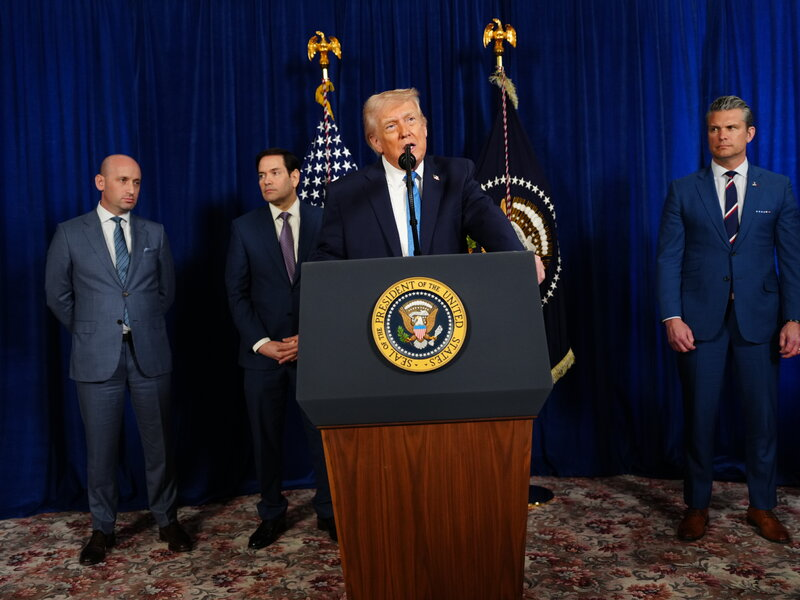
President Trump speaking at a press conference in Mar-a-Lago the morning after the United States invasion of Venezuela. Credit: The Nation
More to Discover



About the Contributor
Vance Evans, Alumni Coordinator