“Lincoln High School believes in creating a positive, welcoming, and equitable environment for all students.” These are the first words of our school’s culture guide, but what actionable steps are available when wrongdoing occurs?
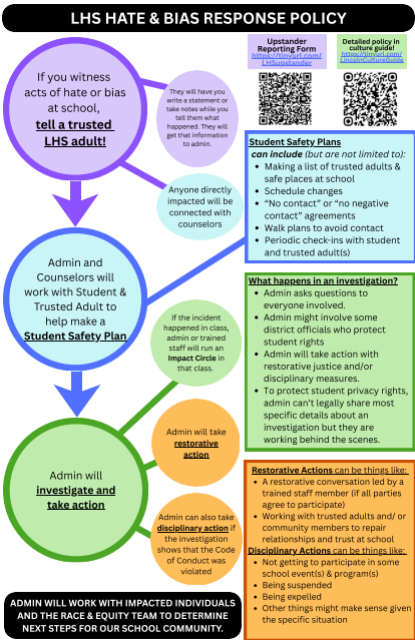
Juniors taking US History Black Studies Honors worked to address issues students face when reporting hate and bias at Lincoln. Their project was focused on clearly outlining the steps students take to report discrimination at Lincoln and inform students of the process that admin takes to address and restore harm.
Before their project, it may have been confusing for students to find guidance on how to report discrimination. Their first instinct may be to talk with counseling, but Momo Fujinaka (’28) says this can be difficult and “[the counselors] are just so busy and it’s hard to get in contact with them.”
The project students undertook was intended to change the issues people faced when knowing how to report and increase the ease and efficiency of reporting.
Anabelle Jentz (‘27) stated, “for the project we’re making a video that will be shown to mentorships to make people aware of the steps you have to take. At the end, we are going to provide an anonymous form that Ms. Jones and Ms. Cassidy developed for this year.”
The anonymity of the form will be a way for students to feel safer when reporting concerns. A study published in the Journal of School Violence has shown that adolescents often do not report bullying and harassment for various factors including shame, parental omniscience, concerns over adult actions taken, and more. The lack of reporting can lead to a culture where reporting is not normalized.
When students do not report discrimination, it takes a toll on both the person facing it and the whole community. A 2023 study published by the CDC revealed that students who experienced racism in schools were found to have increased indicators of suicide risk, substance usage, and poor mental health.
However, when students report discrimination, it improves school culture and can counter these risk factors. In fact, a 2019 study published in the Proceedings of the National Academy of Science revealed that students of color show health advantages when they attend schools that emphasize diversity (the measure used was mentioning diversity in mission statements).
Meyra Pehlivanoglu Noyes (’27) is also contributing to the class project. She hopes that the video will address “racism in schools and raise awareness in the real world.”